

close
Choose Your Site
Global
Social Media


Views: 0 Author: Site Editor Publish Time: 2026-08-31 Origin: Site


Modern commercial architecture increasingly demands highly bespoke spatial configurations. You often find yourself balancing this rising need for custom environments against incredibly strict construction schedules. This creates a challenging tension for project managers and architects alike. Today, digital design phases move at breakneck speeds. However, physical fabrication consistently remains the primary schedule bottleneck for customized build-outs. Standardized products might ship quickly. Tailoring dimensions or finishes, conversely, typically stalls progress on the factory floor.
Partnering with manufacturers who utilize mature, high-precision processing tooling directly compresses these manufacturing lead times. Upgraded infrastructure completely eliminates the traditional tradeoff between deep customization and rapid delivery. You no longer have to sacrifice unique design to meet a deadline. In this article, we will explore exactly how advanced machining reduces bottlenecks. You will learn to evaluate supplier capabilities effectively. Finally, we will outline practical strategies for integrating custom fabrication timelines directly into your critical path without risking late-stage delays.
Manual and semi-manual fabrication methods carry inherent scaling constraints. These limitations become painfully obvious when processing non-standard dimensions. Fabricating bespoke interior wall systems heavily relies on constant manual adjustments. Operators must measure, mark, and cut each unique component. This manual "make-to-order" approach severely restricts how many custom units a facility can produce daily.
Legacy machinery requires extensive manual calibration. Switching between different custom profiles means operators must physically reset mechanical stops. They have to swap out blades and dial in new feed rates manually. These transitions create dormant periods on the factory floor. Production stops entirely while workers calibrate the machinery for the next batch. These small delays accumulate into weeks of lost time across a large project.
Micro-inconsistencies during these manual setups inevitably lead to compounding tolerance errors. A millimeter off at the starting point magnifies as workers assemble the components. This creates a highly frustrating rework loop. Factories routinely scrap misaligned panels. They face unbudgeted remanufacturing time, which pushes your delivery dates further back.
Finally, relying on outdated equipment increases your vulnerability to unexpected machinery downtime. Legacy systems frequently break down under heavy customized workloads. Replacement parts for older machines often take weeks to arrive. When your supplier relies on aging routers or saws, their mechanical breakdowns directly impact your critical path.
Modern fabrication floors look entirely different from traditional wood or metal shops. They rely heavily on CNC (Computer Numerical Control) routing centers. Automated edge-banding machines utilize robotic tool changers to handle the heavy lifting. These systems swap out router bits and saw blades automatically. They transition between complex custom specifications in mere minutes rather than hours. This automation immediately eliminates the dormant setup periods plaguing older factories.
Digital twin technology and CAD/CAM integration streamline this manufacturing process further. Engineers map the workflow directly from digital shop drawings into executable machine code. They bypass manual programming on the factory floor entirely. This direct data pipeline cuts out interpretation delays. It also eliminates the risk of manual data entry errors. The machine knows exactly what to cut the second the design receives approval.
Mature tooling easily handles diverse architectural materials at much higher feed rates. Processing heavy glass, dense acoustic panels, and complex aluminum extrusions requires specific, rigid calibrations. Advanced machines push these diverse materials through the cutting area rapidly. They achieve this high throughput without sacrificing pristine cut quality or compromising structural integrity.
| Production Dimension | Legacy Fabrication Methods | Mature Processing Tooling |
|---|---|---|
| Setup Time | Hours per custom profile | Minutes via automated changers |
| Data Transfer | Manual entry from paper drawings | Direct CAD-to-machine G-code |
| Material Yield | Lower yield due to test cuts | Maximized yield via nesting software |
| Scalability | Constrained by skilled labor availability | Highly scalable continuous operations |
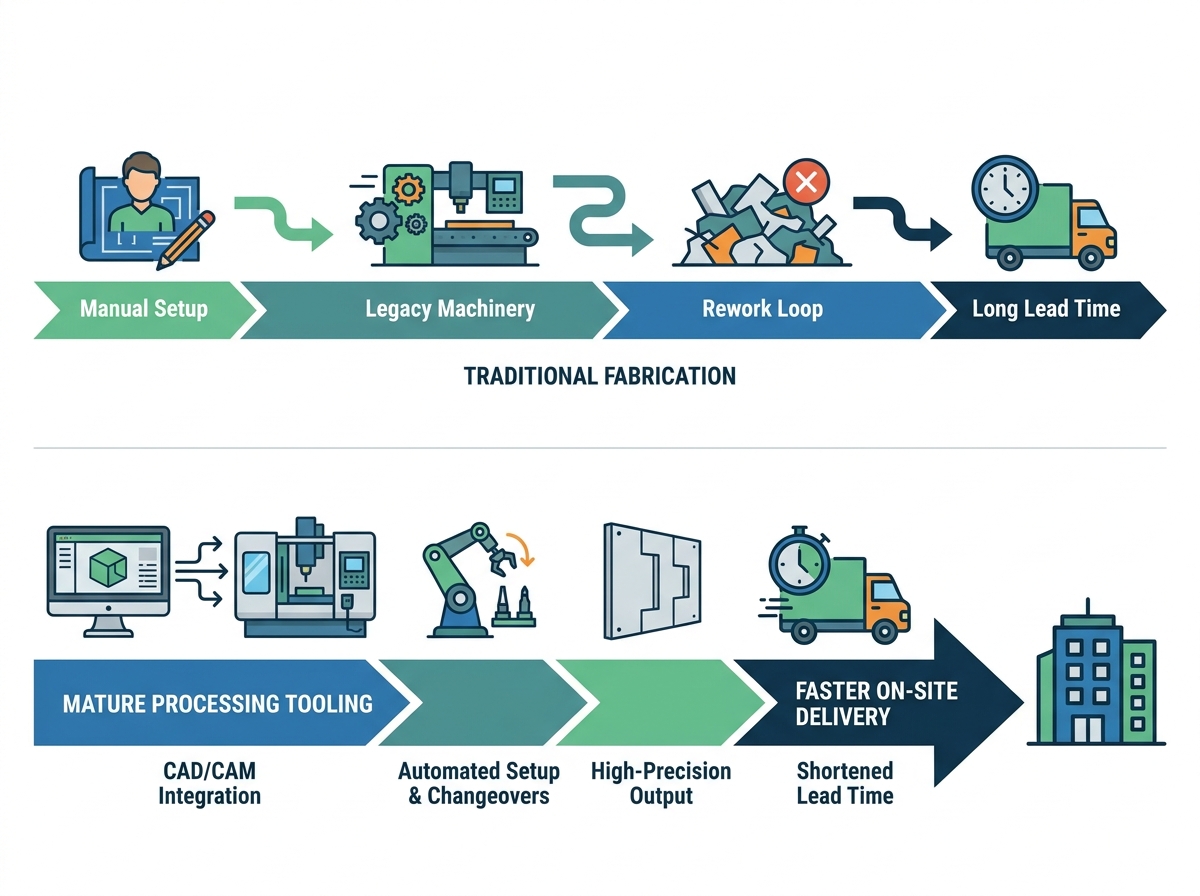
Precision tooling drastically reduces logistical and installation risks on the active job site. Moving the burden of precision from the field to the factory changes everything.
Project managers often mistakenly assume site carpenters can easily trim custom architectural panels. High-grade finishes easily chip or splinter when field-cut with portable tools. Precision factory cuts eliminate this costly risk entirely. The components fit perfectly on the first attempt.
Procurement teams must look far beyond superficial sales promises. You need to verify actual operational maturity before signing any supply contracts. Assessing a manufacturer requires intentional technical diligence. You should tour their facilities and observe their daily operations.
Evaluate your potential suppliers across these specific assessment dimensions:
Watch out for specific red flags during supplier vetting. If you see machine operators manually dimensioning parts on the shop floor, walk away. Heavy reliance on outsourced secondary processing also signals trouble. If a supplier must ship components to a third-party vendor for powder coating, delays will multiply exponentially.
Mature tooling requires absolute, finalized CAD data to function efficiently. You must establish strict design-freeze milestones early in your project schedule. Once you freeze the design, automated fabrication accelerates dramatically. However, any late design changes break the machine code pipeline. Revisions force engineers to rewrite programs, completely negating the speed benefits of advanced tooling.
Remember that raw material availability remains a completely separate variable. Advanced tooling dramatically accelerates physical cutting and shaping. It cannot, however, speed up a delayed international shipment of custom-dyed acoustic felt. You must actively manage raw material lead times independently from the actual fabrication timelines.
Consider implementing a staged delivery strategy for large installations. Phase the delivery of bespoke interior wall systems based strictly on site-readiness. Advanced manufacturing offers incredibly high output predictability. You can align factory output perfectly with your installation crews. This prevents finished custom panels from sitting unprotected on a dusty, active job site.
Verifiable processing maturity serves as the most accurate predictor of lead time reliability. The specific technology your manufacturer uses matters far more than their initial schedule estimates. Standardizing around high-tech fabrication eliminates the chaos usually associated with customized interior build-outs.
Keep these actionable steps in mind as you move forward. Audit the production infrastructure of your shortlisted manufacturers before committing capital. Submit your custom specifications early to secure a tooling-verified lead time estimate. Enforce a hard design-freeze among stakeholders to fully leverage automated CNC fabrication speeds. By separating material sourcing timelines from actual machining cycles, you ensure a smoother, faster delivery.
A: Automated tooling can reduce machining cycle times by 40% to 60%. The most significant time savings come from massive setup reductions. Traditional machines require hours of manual recalibration for custom profiles. Modern CNC routers and robotic tool changers swap specifications in mere minutes, keeping production continuous.
A: Upfront machinery overhead is higher for the manufacturer, but this rarely increases your final purchase price. Higher equipment costs are typically neutralized by drastically reduced labor hours and significantly lower defect rates. You also gain faster time-to-occupancy, which dramatically improves your overall project completion speed.
A: Factory precision directly reduces on-site modifications. Installers do not need to measure, cut, or shim panels in the field. Perfect dimensional accuracy accelerates modular assembly. Your crews simply snap or fasten the pre-engineered components together, drastically reducing unpredictable site labor costs.
A: Cycle time refers to the actual machining duration required to fabricate a specific component. Lead time encompasses the total timeline from your initial order placement to final delivery. Mature tooling directly compresses the physical cycle time while making the broader lead time highly predictable.


