

close
Choose Your Site
Global
Social Media


Views: 0 Author: Site Editor Publish Time: 2026-08-01 Origin: Site


Scaling production and fulfillment introduces unique bottlenecks. Specifically, order consolidation, hardware kitting, and multi-component staging create massive friction points. Demand grows exponentially across commercial real estate and modular construction. Standard fulfillment workflows, like sequential batch picking, fail to maintain required throughput. This operational failure causes severe dock congestion and costly shipping errors.
Facilities face unprecedented pressure today. They must ship large architectural orders quickly. Matching massive panels to tiny screws is incredibly complex. Standard e-commerce models simply do not work for interior wall systems. Floor-based staging consumes too much valuable space. We will explore how automated consolidation buffers and specialized put systems solve this crisis.
Moving from manual staging requires rigorous evaluation. You must assess physical footprint, software integration, and component handling capabilities. You will learn how to evaluate dimensional flexibility. We will also cover execution software requirements. By the end, you will know exactly how to structure your next processing tooling RFP.
Manufacturing output rarely matches fulfillment reality. Factory lines produce large panels rapidly. However, the warehouse struggles to ship complete kits. interior wall systems demand matching large-format items to small-format hardware. You must pair massive acoustic panels, heavy tracks, and aluminum extrusions alongside tiny brackets, acoustic seals, and specialized fasteners. This extreme size disparity breaks standard processing logic. A commercial office buildout might require fifty private offices. The factory pumps out the glass easily. Yet, the warehouse must build fifty unique hardware boxes accurately. If workers miss one hinge, the installation crew stops entirely.
Traditional fulfillment methods fail miserably here. Standard e-commerce put walls lack physical dimensions for architectural parts. They fit small retail goods, not building materials. Attempting to force large extrusions into standard cubbies causes severe workflow jams. Conversely, floor-based manual staging causes different problems. It consumes excessive square footage. Forklifts must navigate around huge, unstructured pallets. Workers walk miles daily searching for matching hardware. This chaotic movement increases material handling damage risks significantly.
We must define clear success criteria to solve this bottleneck. Upgrading processing tooling requires measurable goals. Track the following metrics carefully to validate your operational improvements.
Successful modernization relies on these baseline numbers. They prove your initial business case.
You have several distinct hardware paths available. Choosing the right tooling depends entirely on your specific product mix. High-volume custom orders require different solutions than standardized partition runs. We break these down into three primary categories.
Heavy-duty put wall systems and kitting stations offer excellent control. Vendors adapt standard put-to-light frameworks specifically for hardware and sub-assembly components. These heavy-duty versions use reinforced racking. They integrate bright visual cues to guide workers quickly. This solution works best for high-SKU hardware kitting. You must marry these small kits to bulk panel orders before loading the truck. It isolates complex small-parts picking from dangerous forklift traffic.
Automated buffer and sequencing systems handle the heavy lifting. They utilize conveyor-driven or AMR-assisted staging lanes. These systems physically sequence heavy extrusions and panels. The software ensures they arrive at the shipping dock simultaneously. This approach eliminates dock-door congestion. It works best for facilities handling high direct-to-site fulfillment demands. Construction sites require strict truck-loading sequences. Workers must unload panels in the exact order of installation.
Hybrid consolidation hubs combine both methods. They blend manual forklift-driven macro-staging alongside automated micro-fulfillment put walls. You handle panels manually. You automate the hardware kits. While popular, this approach carries risks. Hybrid models require highly sophisticated Warehouse Execution Systems (WES). The software must prevent timing mismatches. If hardware finishes three hours before panels arrive, staging bays overflow quickly. Synchronization remains mandatory.
| Tooling Category | Primary Function | Best Fit Scenario | Key Limitation |
|---|---|---|---|
| Heavy-Duty Put Walls | Hardware kitting & visual sorting | High-SKU small parts matching | Cannot process large panels |
| Automated Buffers | Sequencing bulky extrusions | Strict truck-loading sequences | High floor space requirement |
| Hybrid Hubs | Blends macro and micro staging | Variable order profiles | Requires complex WES integration |
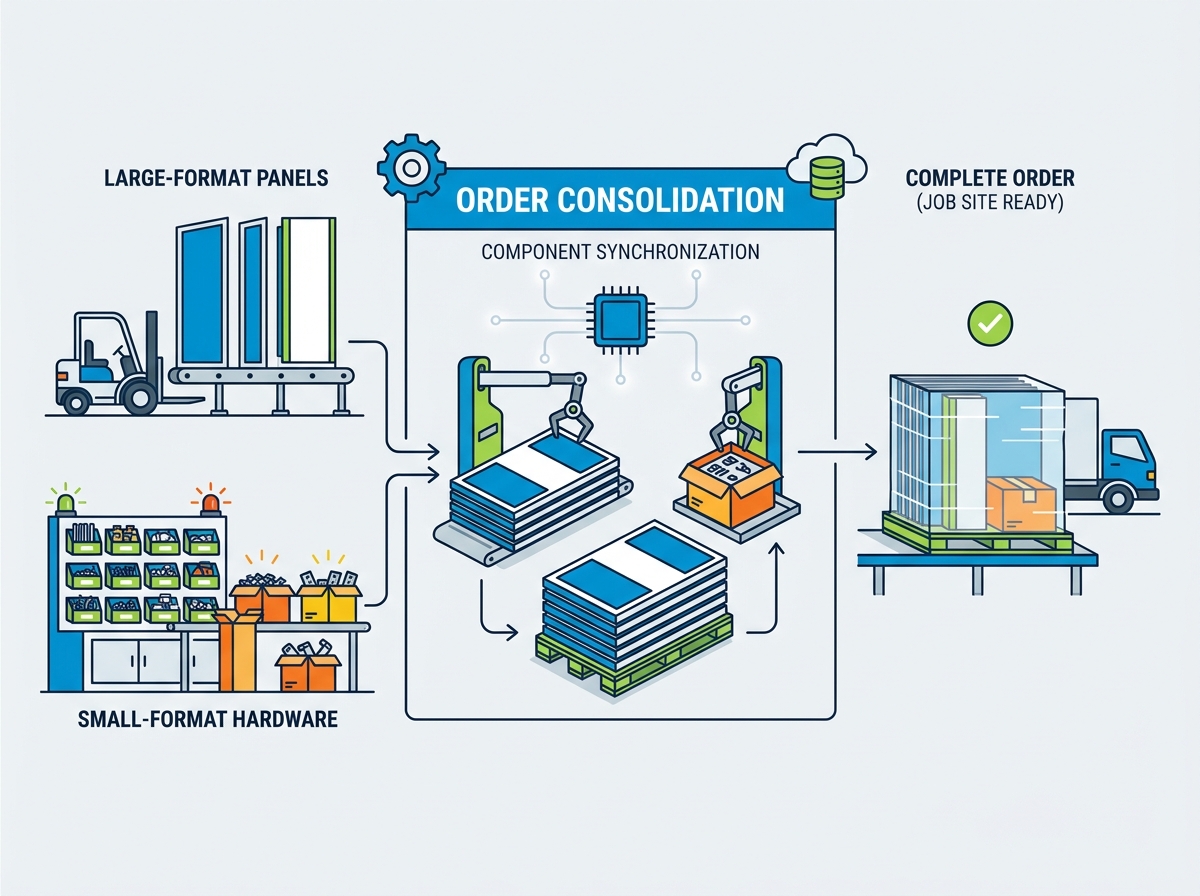
Selecting the right vendor requires strict evaluation. You cannot rely on generic marketing brochures. Evaluating dimensional flexibility is your first critical step. Assess how the physical infrastructure handles varying sizes of interior wall systems. Your product mix likely includes standard glass partitions alongside solid acoustic panels. The tooling must accommodate both extremes seamlessly. Assess vertical space utilization thoroughly. Compare it against floor-level accessibility. Heavy glass needs floor-level staging to prevent lifting injuries. Lightweight acoustic panels can utilize vertical racking safely.
The software ecosystem demands intense scrutiny. Do not accept vendor claims of "seamless WMS integration" at face value. Many integrators underestimate the complexity of building materials. Require complete API documentation upfront. Demand latency benchmarks for real-time inventory allocation. Milliseconds matter when lights direct human movement. Latency causes physical traffic jams.
Evaluate the logic used for order routing carefully. Ask vendors specific operational questions. Can the software intelligently pause hardware kitting if corresponding wall panels fail quality control? If a panel breaks during handling, the system must freeze the hardware kit immediately. Continuing to kit hardware for a delayed panel wastes valuable buffer space.
Throughput resiliency proves system durability. You must stress-test the vendor's throughput claims. Use your peak demand historical data. Averages hide operational stress points. Account for daily exceptions.
Robust tooling handles exceptions gracefully. Brittle systems crash when single components go missing.
Deploying new automation introduces operational shock. The danger of "Big Bang" deployments remains severe. Transitioning processing tooling during peak production often leads to catastrophic fulfillment delays. Teams cannot learn new software while fighting daily shipping fires. Changing everything overnight guarantees failure.
We recommend phased rollouts universally. Shift only your hardware kitting to the new put wall system first. Let workers master the light-directed picking. Allow the WMS integration to stabilize. Once hardware kitting runs smoothly, introduce panel sequencing. This phased approach isolates variables. It protects your daily shipping volume.
Operational change carries hidden friction points. Training material handlers takes significant time. They must learn to rely on light-directed or terminal-directed processing. They must stop using paper pick-tickets entirely. This behavioral shift requires patience and strict management. Furthermore, you must evaluate packaging modifications. Existing packaging and dunnage might not fit the new automated flow. Automated conveyors often reject oversized or loose shrink-wrap. Standardizing your outbound packaging becomes a mandatory prerequisite.
Safety and compliance considerations dictate your physical layout. You must review weight load limits on consolidation racking. Architectural parts weigh significantly more than standard retail goods. Conduct rigorous ergonomic assessments for workers. Handling heavy components at fixed processing stations causes strain. Use height-adjustable lifts where necessary. Adhering to OSHA lifting guidelines protects your workforce and prevents costly downtime.
You must establish a concrete baseline before writing an RFP. Audit your current metrics honestly. Document your existing cost-per-order manually. Measure your current staging square footage. Track your precise error rates over a ninety-day period. Do this before contacting vendors. You cannot measure improvement without knowing where you stand today.
| Operational Metric | Current State (Manual) | Target State (Automated) |
|---|---|---|
| Cost-Per-Order | Calculate labor hours used | Target 30% reduction |
| Staging Footprint | Measure total floor grid | Target 50% vertical recovery |
| Error Rate | Count missing hardware instances | Target near-zero exceptions |
Vendor vetting criteria should filter out retail-focused integrators immediately. Prioritize integrators possessing proven case studies in building materials. They must understand modular construction entirely. They should specialize in oversized goods. Standard retail e-commerce vendors fail to grasp the weight and timing complexities. Demand a Proof of Concept (PoC). Ask for a detailed simulation model. Crucially, force them to use your actual SKU master data. Generic data proves nothing.
Structuring the business case requires specific focus. Direct the ROI model toward labor reallocation. Show how automation moves workers from traveling to packing. Highlight the reduction in expedited freight costs. Missing parts currently force you to overnight heavy hardware to job sites. Eliminating these errors yields massive savings. Finally, demonstrate increased facility capacity. Show executives how optimized consolidation avoids a physical building expansion.
Optimizing order fulfillment for interior wall systems is not about buying the fastest equipment. It is entirely about synchronization. The fastest hardware picker fails if the heavy panels trail two hours behind. Systems must communicate flawlessly to keep dock doors flowing.
Successful deployment bridges the gap between bulky material handling and precise hardware kitting. Phased implementations protect daily throughput. Rigorous WES testing prevents Go-Live disasters. Ultimately, matching every bracket to every panel protects project margins directly on the construction site.
Take immediate action today. Audit your current staging footprint. Request API latency documentation from your WMS provider. Plan a limited pilot test focusing strictly on hardware kitting integration. Modernizing this workflow secures your capacity for future market growth.
A: While standard put walls handle small goods, adapted systems use light-directed staging bays or floor-level buffer zones to synchronize the consolidation of large panels with their respective hardware kits.
A: Depending on legacy software, integration testing for WES/WMS routing logic typically takes 3 to 6 months before physical hardware is fully operational.
A: Calculations must account for peak order volume, the dimensional data of your largest wall panels, required operator walkways, and the temporary storage duration of components waiting for order completion.
A: Yes, modern execution software allows dynamic slotting, meaning the processing system can reconfigure consolidation rules on the fly for bespoke dimensions without hard-coded racking changes.


