

close
Choose Your Site
Global
Social Media


Views: 0 Author: Site Editor Publish Time: 2026-08-16 Origin: Site


High-mix, low-volume manufacturing is the new standard for architectural spaces. However, the true margin-killer is setup time, not material costs. Designers constantly demand highly bespoke decorative panels. They want unique geometries, intricate textures, and flawless finishes. As demand grows for highly bespoke decorative panels and integrated interior wall systems, manufacturers face a critical turning point. You must transition from static, dedicated production lines to agile, tailored tooling layouts.
We see too many facilities struggling to adapt. Old jigs slow everything down. This guide breaks down how to evaluate, select, and implement adaptive tooling frameworks. You will learn how to protect margins during highly diversified custom runs. We will show you how to achieve this operational agility without sacrificing output quality. The strategies detailed below offer a blueprint for transforming your factory floor into a responsive, highly profitable environment.
Relying on fixed jigs and standard fixtures for highly diversified orders leads to excessive changeover times. This directly reduces Overall Equipment Effectiveness (OEE). OEE relies heavily on machine availability. When operators spend forty-five minutes unbolting and realigning clamps for a new panel run, availability plummets. Standard fixtures work beautifully for identical, high-volume production. They fail miserably when every batch requires a different dimension. You lose precious hours every week simply preparing the machine to cut.
Rigid setups also struggle to secure varying geometries. 3D textured panels and non-standard radii require specific hold-down strategies. Standard jigs cannot grip these unique shapes evenly. This leads to vibration. Vibration causes chatter marks on the panel surface. Chatter ruins the aesthetic finish, increasing material waste and rework. Every scrapped panel eats directly into your profit margin. When producing high-end interior wall systems, the material costs are often substantial. You cannot afford a low yield rate caused by inadequate workholding.
Finally, standard lines create a harsh scalability ceiling. They cap your capacity to take on complex, higher-margin architectural projects. When a client requests a highly varied, custom-fluted panel sequence, a rigid floor plan struggles to keep pace. Scaling output becomes reliant on adding headcount rather than improving machine utilization. You end up hiring more operators just to swap jigs manually. True scalability requires your machines to do more work in less time. Tailored tooling unlocks this potential.
Upgrading your floor requires understanding the available technologies. Modern tooling frameworks fall into three primary categories. Each solves different production bottlenecks.
Tooling Layout Comparison Matrix
| Tooling Category | Initial Setup Speed | Geometric Flexibility | Ideal Production Scenario |
|---|---|---|---|
| Modular Quick-Change | Moderate (5-10 mins) | High for standard shapes | Frequent dimensional changes on flat panels |
| Automated Parametric | Instantaneous (Automated) | Very High | Continuous single-piece flow of varying designs |
| Hybrid On-Demand | Slow (requires printing/machining) | Maximum (Bespoke) | Complex 3D textures and extreme edge profiles |
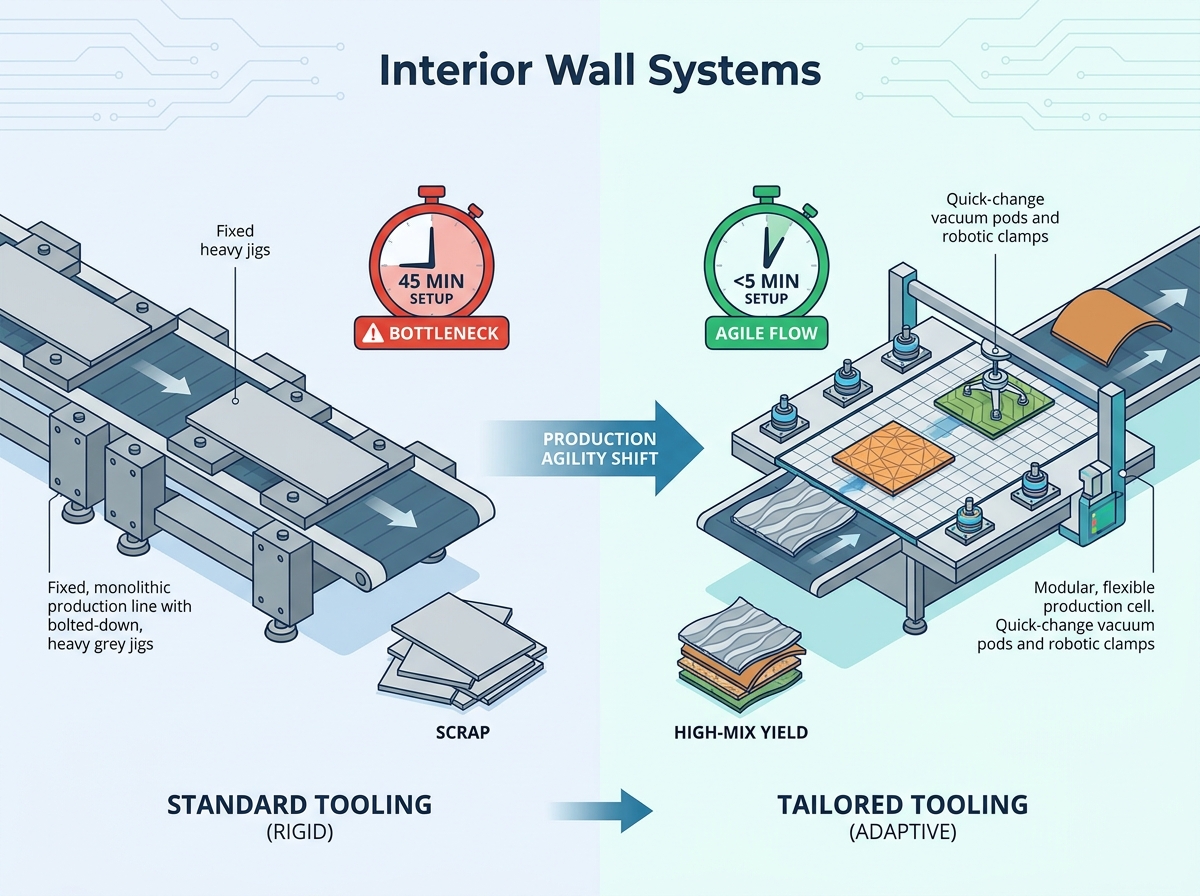
Purchasing adaptive tooling requires strict financial justification. You must map physical features directly to measurable business outcomes. We use a Features-to-Outcomes framework to clarify this process. Do not buy features you do not need. Buy the capabilities your floor desperately lacks.
Evaluating tailored tooling also requires analyzing quality and compliance metrics. Rigid, outdated fixtures cause microscopic movements during aggressive milling. Tailored tooling reduces vibration and chatter. It secures the workpiece perfectly. This ensures tighter tolerances. Tighter tolerances help you meet strict commercial compliance standards for modular interior wall systems. When panels snap together flawlessly on a job site, your brand reputation strengthens. Rework drops to zero. First-pass yield becomes your primary driver of profitability.
Installing new equipment disrupts workflow. Acknowledging the operational reality of production halts during retrofits is vital. You cannot just rip out old machines on a Tuesday and expect full production by Wednesday. Establish phased rollout strategies. Keep baseline production running on legacy lines while validating the new tooling cell. We highly recommend running a transition schedule over a weekend or during scheduled maintenance windows.
The operator learning curve presents another massive risk. Even the most advanced tooling layout will fail if floor staff cannot intuitively execute changeovers. Operators often resist new technology. They fear automation makes their skills obsolete. You must reframe this transition as upskilling. Factor in the cost and time of mandatory hands-on vendor training. Do not rely on manuals. Demand floor-level workshops. Operators need muscle memory to trust the new clamps, pods, and software interfaces.
Finally, prepare for software and CAD/CAM integration friction. Tailored tooling often requires updated post-processors to translate your designs into machine code. Assess the risk of compatibility issues early. Legacy ERP systems might struggle to schedule dynamic, one-off runs efficiently. Ensure your CAM software can automatically generate the positioning logic for parametric pods. If your programmers must manually type G-code to move vacuum pods, you defeat the entire purpose of the upgrade. Test this digital handshake long before the physical equipment arrives.
Your relationship with a tooling vendor extends far beyond the purchase order. You are buying a partnership in manufacturing agility. Begin with strict Proof of Concept (PoC) requirements. Demand pilot runs using your most difficult, highest-variability decorative panel designs. Do not accept standardized demo metrics. A vendor showing you how fast they can cut a plain MDF square proves nothing. Make them cut your complex, deep-fluted acoustic panels. Watch how long it takes their system to switch from a large panel to a tiny edge-piece.
Next, evaluate their end-to-end engineering support. Shortlist vendors who offer design-for-manufacturability (DFM) audits alongside their physical products. A strong partner will look at your interior wall systems and suggest minor design tweaks. These tweaks might make the panels drastically easier to grip and machine. They should understand your material choices, from dense solid surfaces to lightweight honeycomb composites.
Lastly, scrutinize Service Level Agreements (SLAs) and maintenance contracts. When an automated tooling cell goes down, production stops entirely. Evaluate the partner's responsiveness for replacement parts. Do they offer remote diagnostic troubleshooting? How quickly can they dispatch a technician? Prioritize domestic or highly responsive regional support for critical line components. A cheap system from an overseas vendor becomes incredibly expensive when you wait three weeks for a replacement servo motor.
Investing in tailored production tooling is not strictly a capacity play; it is an agility play. Profitability in diversified custom orders hinges on minimizing the friction between unique runs. The faster you adapt to the next bespoke panel design, the higher your margins climb.
Your strategic next step is clear. Conduct a time-study on your current changeover processes. Measure exactly how many minutes your operators spend swapping jigs today. Establish a baseline cost of delay. This data provides the undeniable financial justification needed for approaching tooling vendors and upgrading your floor.
A: Varies by production volume, but most facilities running high-mix decorative panels target an 18-to-24-month payback period based on labor savings and reduced scrap.
A: Yes, but it requires specifying dynamic load capacities during the evaluation phase. Vacuum matrix systems may need supplemental mechanical clamping for dense structural layers within interior wall systems.
A: Most adaptive systems are backward-compatible, though translating old manual jig positions into the new digital/modular framework requires a one-time programming or mapping effort.


